Robotics
RoboCup Rescue Maze (INTERNATIONALS 2026!)
A fully autonomous rescue robot designed to explore unknown mazes, detect victims using onboard AI, avoid obstacles, climb ramps, deploy rescue kits, and safely return to the starting tile.
Year :
2026
Industry :
International
Client :
RoboCup: Rescue Maze
Project Duration :
10 months

Overview
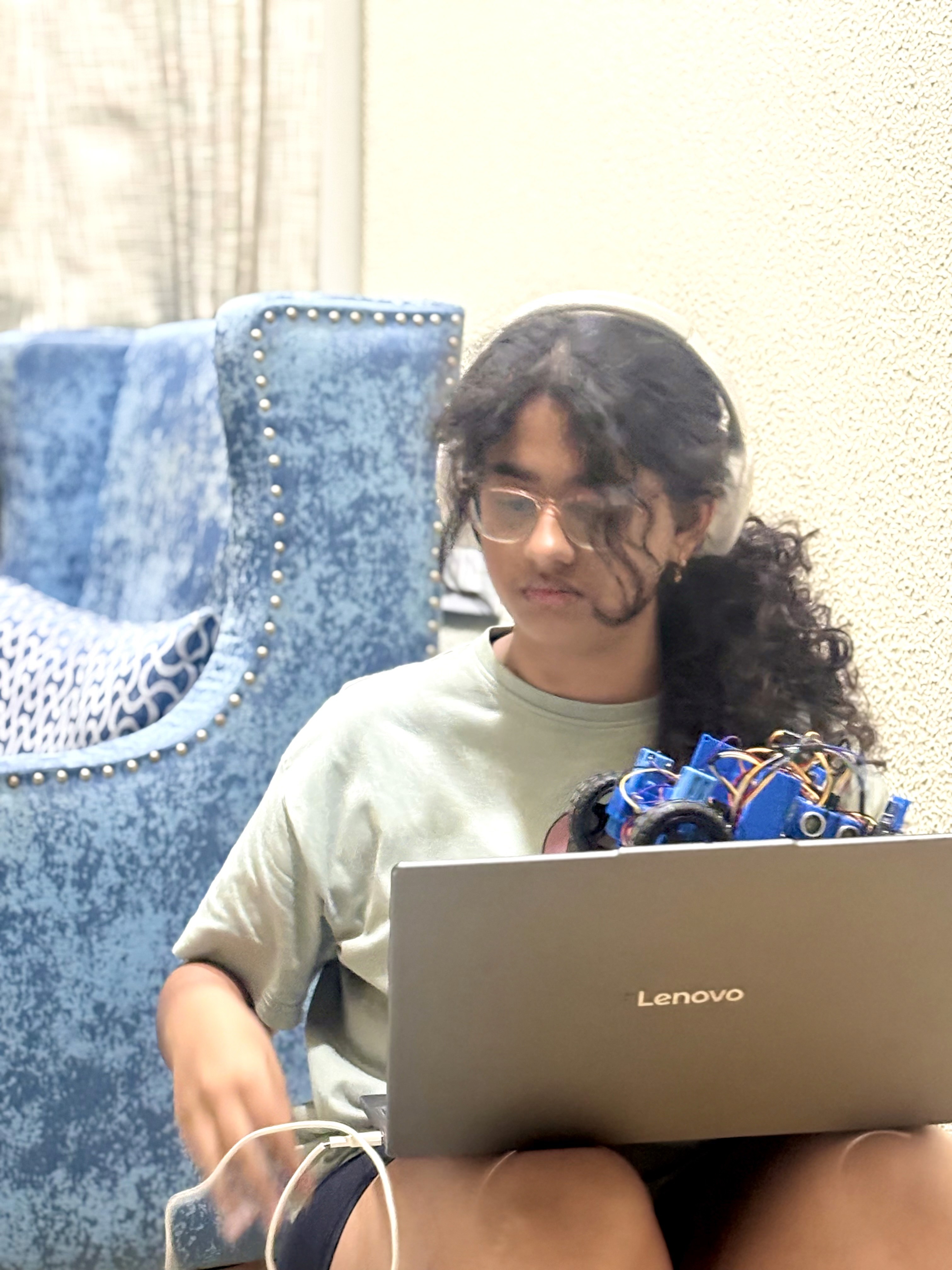
For RoboCup Junior Rescue Maze 2026, I helped develop an autonomous rescue robot designed to navigate a simulated disaster environment without any human intervention. Every decision, from choosing which path to explore to identifying victims and returning safely to the start, is made entirely onboard in real time.
The robot explores an unknown maze while building its own internal map, using a hybrid Depth-First Search (DFS) and Breadth-First Search (BFS) navigation system to efficiently cover new territory and recover from dead ends. Throughout the run, it traverses ramps, stairs, and obstacles, identifies hazardous tiles using onboard sensors, detects victims with an AI-powered camera, and deploys the correct number of rescue kits based on the victim type.
My primary contribution focused on the software architecture, where I designed and integrated the navigation algorithms, mapping logic, obstacle handling, and subsystem communication into a single autonomous system that could reliably operate under competition conditions.

Tech Stack
Programming Languages
C++
Python
MicroPython
Embedded Systems
Cytron Maker Pi RP2040
OpenMV H7+
Algorithms
Depth-First Search (DFS)
Breadth-First Search (Flood Fill)
PID Wall Following
Gyroscope Heading Correction
Sensor Fusion
Machine Learning
Edge Impulse
Embedded Computer Vision
Sensors
HC-SR04 Ultrasonic Sensors
MPU6050 IMU
TCS34725 Color Sensor
OpenMV Camera
Hardware
Custom 3D Printed PLA Chassis
Fusion 360
Servo Rescue Kit Mechanism
Differential Drive Robot

Challenges and Solutions
One of the biggest challenges was replacing our previous left-wall-following approach with a more intelligent navigation system. During nationals, the robot became trapped in loops on floating tile layouts, making it clear that a reactive algorithm alone wasn't sufficient. To solve this, I developed and integrated a hybrid Depth-First Search (DFS) and Breadth-First Search (BFS) navigation system, allowing the robot to explore unknown mazes efficiently while always maintaining a valid path back to the starting tile.
Another major challenge was integrating multiple subsystems into a single reliable control loop. Navigation, obstacle detection, ramp and staircase traversal, victim detection, tile identification, and rescue kit deployment all needed to operate simultaneously without interfering with one another. This required extensive debugging of sensor timing, state management, and communication between modules to ensure the robot could make consistent real-time decisions.
Finally, competition environments are unpredictable. Sensor readings varied under different lighting conditions, wheel drift accumulated over long runs, and physical obstacles introduced alignment errors. Through iterative testing and calibration, we refined the robot's navigation, improved sensor reliability, and built recovery behaviours that allowed the robot to adapt rather than fail when conditions changed.
Experience and Learnings
This was one of the most technically challenging and rewarding projects I've worked on to date. As my first robotics competition, I never expected our team to qualify for the RoboCup Junior World Championship, let alone place 2nd nationally and finish 15th internationally, making us the highest-ranked Indian team in our division.
The competition taught me that robotics is far more than writing code or assembling hardware. It's about designing systems that remain reliable under unpredictable, real-world conditions, where every sensor reading, timing issue, and mechanical imperfection can influence the final outcome. I gained invaluable experience in debugging complex autonomous systems, integrating multiple subsystems into a cohesive architecture, and approaching problems with an iterative engineering mindset.
Competing in South Korea was equally inspiring. Watching teams from around the world showcase remarkably refined robots, innovative mechanisms, and creative solutions broadened my perspective on what was possible. Rather than feeling intimidated, it motivated me to push my own skills further and think bigger about future projects.
Looking back, RoboCup felt like opening the door to an entirely new world of engineering. It reinforced my passion for robotics, taught me how much I still have to learn, and left me excited to return with an even stronger robot next year.

More Projects
New release
Preview
Robotics
RoboCup Rescue Maze (INTERNATIONALS 2026!)
A fully autonomous rescue robot designed to explore unknown mazes, detect victims using onboard AI, avoid obstacles, climb ramps, deploy rescue kits, and safely return to the starting tile.
Year :
2026
Industry :
International
Client :
RoboCup: Rescue Maze
Project Duration :
10 months
Overview
For RoboCup Junior Rescue Maze 2026, I helped develop an autonomous rescue robot designed to navigate a simulated disaster environment without any human intervention. Every decision, from choosing which path to explore to identifying victims and returning safely to the start, is made entirely onboard in real time.
The robot explores an unknown maze while building its own internal map, using a hybrid Depth-First Search (DFS) and Breadth-First Search (BFS) navigation system to efficiently cover new territory and recover from dead ends. Throughout the run, it traverses ramps, stairs, and obstacles, identifies hazardous tiles using onboard sensors, detects victims with an AI-powered camera, and deploys the correct number of rescue kits based on the victim type.
My primary contribution focused on the software architecture, where I designed and integrated the navigation algorithms, mapping logic, obstacle handling, and subsystem communication into a single autonomous system that could reliably operate under competition conditions.
Tech Stack
Programming Languages
C++
Python
MicroPython
Embedded Systems
Cytron Maker Pi RP2040
OpenMV H7+
Algorithms
Depth-First Search (DFS)
Breadth-First Search (Flood Fill)
PID Wall Following
Gyroscope Heading Correction
Sensor Fusion
Machine Learning
Edge Impulse
Embedded Computer Vision
Sensors
HC-SR04 Ultrasonic Sensors
MPU6050 IMU
TCS34725 Color Sensor
OpenMV Camera
Hardware
Custom 3D Printed PLA Chassis
Fusion 360
Servo Rescue Kit Mechanism
Differential Drive Robot
Challenges and Solutions
One of the biggest challenges was replacing our previous left-wall-following approach with a more intelligent navigation system. During nationals, the robot became trapped in loops on floating tile layouts, making it clear that a reactive algorithm alone wasn't sufficient. To solve this, I developed and integrated a hybrid Depth-First Search (DFS) and Breadth-First Search (BFS) navigation system, allowing the robot to explore unknown mazes efficiently while always maintaining a valid path back to the starting tile.
Another major challenge was integrating multiple subsystems into a single reliable control loop. Navigation, obstacle detection, ramp and staircase traversal, victim detection, tile identification, and rescue kit deployment all needed to operate simultaneously without interfering with one another. This required extensive debugging of sensor timing, state management, and communication between modules to ensure the robot could make consistent real-time decisions.
Finally, competition environments are unpredictable. Sensor readings varied under different lighting conditions, wheel drift accumulated over long runs, and physical obstacles introduced alignment errors. Through iterative testing and calibration, we refined the robot's navigation, improved sensor reliability, and built recovery behaviours that allowed the robot to adapt rather than fail when conditions changed.
Experience and Learnings
This was one of the most technically challenging and rewarding projects I've worked on to date. As my first robotics competition, I never expected our team to qualify for the RoboCup Junior World Championship, let alone place 2nd nationally and finish 15th internationally, making us the highest-ranked Indian team in our division.
The competition taught me that robotics is far more than writing code or assembling hardware. It's about designing systems that remain reliable under unpredictable, real-world conditions, where every sensor reading, timing issue, and mechanical imperfection can influence the final outcome. I gained invaluable experience in debugging complex autonomous systems, integrating multiple subsystems into a cohesive architecture, and approaching problems with an iterative engineering mindset.
Competing in South Korea was equally inspiring. Watching teams from around the world showcase remarkably refined robots, innovative mechanisms, and creative solutions broadened my perspective on what was possible. Rather than feeling intimidated, it motivated me to push my own skills further and think bigger about future projects.
Looking back, RoboCup felt like opening the door to an entirely new world of engineering. It reinforced my passion for robotics, taught me how much I still have to learn, and left me excited to return with an even stronger robot next year.
More Projects
New release
Preview
Robotics
RoboCup Rescue Maze (INTERNATIONALS 2026!)
A fully autonomous rescue robot designed to explore unknown mazes, detect victims using onboard AI, avoid obstacles, climb ramps, deploy rescue kits, and safely return to the starting tile.
Year :
2026
Industry :
International
Client :
RoboCup: Rescue Maze
Project Duration :
10 months
Overview
For RoboCup Junior Rescue Maze 2026, I helped develop an autonomous rescue robot designed to navigate a simulated disaster environment without any human intervention. Every decision, from choosing which path to explore to identifying victims and returning safely to the start, is made entirely onboard in real time.
The robot explores an unknown maze while building its own internal map, using a hybrid Depth-First Search (DFS) and Breadth-First Search (BFS) navigation system to efficiently cover new territory and recover from dead ends. Throughout the run, it traverses ramps, stairs, and obstacles, identifies hazardous tiles using onboard sensors, detects victims with an AI-powered camera, and deploys the correct number of rescue kits based on the victim type.
My primary contribution focused on the software architecture, where I designed and integrated the navigation algorithms, mapping logic, obstacle handling, and subsystem communication into a single autonomous system that could reliably operate under competition conditions.
Tech Stack
Programming Languages
C++
Python
MicroPython
Embedded Systems
Cytron Maker Pi RP2040
OpenMV H7+
Algorithms
Depth-First Search (DFS)
Breadth-First Search (Flood Fill)
PID Wall Following
Gyroscope Heading Correction
Sensor Fusion
Machine Learning
Edge Impulse
Embedded Computer Vision
Sensors
HC-SR04 Ultrasonic Sensors
MPU6050 IMU
TCS34725 Color Sensor
OpenMV Camera
Hardware
Custom 3D Printed PLA Chassis
Fusion 360
Servo Rescue Kit Mechanism
Differential Drive Robot
Challenges and Solutions
One of the biggest challenges was replacing our previous left-wall-following approach with a more intelligent navigation system. During nationals, the robot became trapped in loops on floating tile layouts, making it clear that a reactive algorithm alone wasn't sufficient. To solve this, I developed and integrated a hybrid Depth-First Search (DFS) and Breadth-First Search (BFS) navigation system, allowing the robot to explore unknown mazes efficiently while always maintaining a valid path back to the starting tile.
Another major challenge was integrating multiple subsystems into a single reliable control loop. Navigation, obstacle detection, ramp and staircase traversal, victim detection, tile identification, and rescue kit deployment all needed to operate simultaneously without interfering with one another. This required extensive debugging of sensor timing, state management, and communication between modules to ensure the robot could make consistent real-time decisions.
Finally, competition environments are unpredictable. Sensor readings varied under different lighting conditions, wheel drift accumulated over long runs, and physical obstacles introduced alignment errors. Through iterative testing and calibration, we refined the robot's navigation, improved sensor reliability, and built recovery behaviours that allowed the robot to adapt rather than fail when conditions changed.
Experience and Learnings
This was one of the most technically challenging and rewarding projects I've worked on to date. As my first robotics competition, I never expected our team to qualify for the RoboCup Junior World Championship, let alone place 2nd nationally and finish 15th internationally, making us the highest-ranked Indian team in our division.
The competition taught me that robotics is far more than writing code or assembling hardware. It's about designing systems that remain reliable under unpredictable, real-world conditions, where every sensor reading, timing issue, and mechanical imperfection can influence the final outcome. I gained invaluable experience in debugging complex autonomous systems, integrating multiple subsystems into a cohesive architecture, and approaching problems with an iterative engineering mindset.
Competing in South Korea was equally inspiring. Watching teams from around the world showcase remarkably refined robots, innovative mechanisms, and creative solutions broadened my perspective on what was possible. Rather than feeling intimidated, it motivated me to push my own skills further and think bigger about future projects.
Looking back, RoboCup felt like opening the door to an entirely new world of engineering. It reinforced my passion for robotics, taught me how much I still have to learn, and left me excited to return with an even stronger robot next year.
More Projects
New release
Preview